Specialists in treating online gambling addiction in adolescents
Desconect@ was born in 2012, a time when society was not yet aware of the risks of online gambling addiction in adolescents. The dependency that online gambling and betting platforms have generated has exceeded all educational and health forecasts.
That is why we rely on a multidisciplinary team full of specialists in the field, with whom we can deal with one of the most common problems among adolescents in today’s society.
What is online gaming addiction?
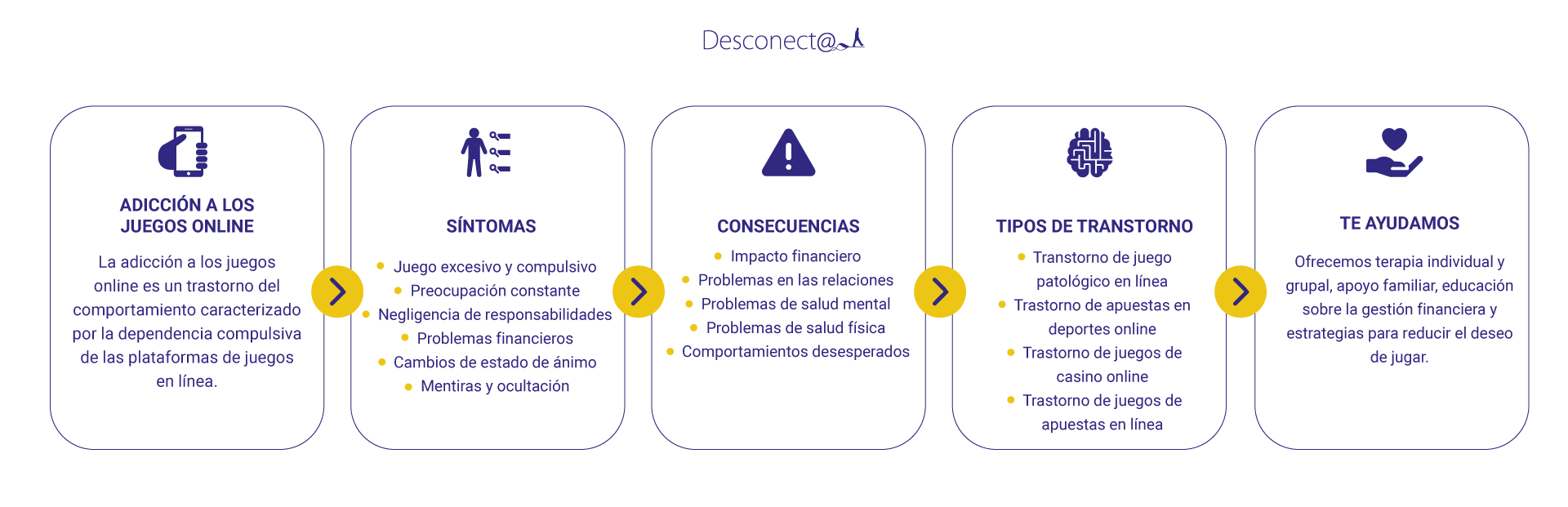
Online gaming addiction is a behavioral disorder characterized by compulsive dependence on online gaming platforms. Affected individuals may experience significant problems in their daily lives due to their excessive gaming behavior, affecting their mental health, personal relationships, and financial stability.
Symptoms of online gaming addiction
-
Excessive and compulsive gaming:
Spending long hours on gaming platforms, often beyond the planned time. -
Constant worry:
Thinking about the next game for most of the day. -
Neglect of responsibilities:
Neglecting family, work, or academic obligations to gamble.
-
Financial problems:
Spending money on games, accumulating debts, or asking for money. -
Mood changes:
Feelings of anxiety, irritability, or depression when unable to gamble or after losses. -
Lying and concealment:
Hiding time and money spent on gambling from loved ones.
Consequences of online gambling addiction
-
Financial impact:
Significant loss of money and accumulation of debt, which can lead to serious financial problems. -
Problems in personal relationships:
Conflicts with family and friends due to lack of honesty and time spent gambling. -
Mental health problems:
Increased anxiety, depression and stress due to financial losses and emotional pressure related to gambling.
-
Physical health problems:
Prolonged stress that can lead to physical problems such as insomnia, headaches and digestive problems. -
Desperate behaviors:
In extreme cases, it can lead to criminal behavior to obtain money to gamble.
Types of disorders within online gaming addiction
- Online gaming addiction can manifest itself in various ways:
-
Internet Gaming Disorder
This disorder is recognized by the World Health Organization (WHO) and the American Psychiatric Association (APA). It is characterized by compulsive and excessive use of video games, leading to a loss of control over playing time, distorted priorities, and continued gaming behaviors despite negative consequences.
Symptoms: Constant preoccupation with gaming, inability to reduce gaming time, use of gaming to escape emotional problems, and continuous lying about time spent gaming. -
Gaming-Related Anxiety Disorder
Obsession with online gaming can lead to elevated levels of anxiety, especially when the individual is unable to play or when performance in the game is not as expected.
Symptoms: Feeling restless or nervous when not playing, constant fear of losing at gaming or not meeting gaming expectations, and performance-related anxiety attacks in the game.
Depressive Disorder -
Depressive Disorder
Online gaming addiction may contribute to the development of depressive symptoms, especially if the individual experiences social isolation, academic or work failure, or family problems due to their gaming behavior.
Symptoms: Persistent feelings of sadness or emptiness, loss of interest in activities outside of gaming, fatigue, and recurring negative thoughts about themselves or their future. -
Conduct Disorder
This disorder can manifest in adolescents and young people who, due to their addiction to online games, adopt problematic behaviors, such as lying, stealing or failing to fulfill responsibilities in order to play.
Symptoms: Acting in a defiant or aggressive manner, missing school or work, lying about playing time or money spent on games, and problems with the law or authority. -
Obsessive-Compulsive Disorder (OCD) Related to Gaming
Some individuals develop compulsive rituals related to online gaming, such as the need to perform certain actions in the game in a specific way to reduce anxiety.
Symptoms: Performing repetitive actions in the game, such as constantly checking statistics or completing tasks in a specific order, and feeling a strong need to perform these actions to avoid a feeling of discomfort. -
Gaming-Related Sleep Disorder
Excessive gaming can severely disrupt sleep patterns, leading to insomnia or poor quality sleep.
Symptoms: Difficulty falling asleep due to overstimulation from gaming, staying up all night to play, and feeling constantly tired or exhausted during the day. -
Impulsive Disorder
Impulsivity can lead to uncontrolled gambling behavior, where the individual makes rash decisions within the game, often spending real money without thinking about the consequences.
Symptoms: Making impulsive purchases within the game, difficulty resisting the temptation to gamble, and rash actions in and out of the game that can lead to financial or social problems. -
Gaming-Related Dissociative Identity Disorder
In extreme cases, some gamers may develop a strong identification with their in-game character or avatar, leading to a dissociation from their real-life identity.
Symptoms: Preferring the game character's identity over their real-life one, difficulty connecting with people outside of the game environment, and a feeling of emptiness or loss when not gaming.
Frequently Asked Questions About Online Gaming Addiction in Teens
- Spending long hours playing, even at the expense of other important activities.
- Difficulty cutting down on gaming time, despite attempts to do so.
- Neglecting school, family, or social responsibilities.
- Irritability, anxiety, or sadness when unable to play.
- Preferring to play over interacting with friends or family in real life.
First, try talking to your child in an open, non-confrontational manner. Observe his or her behavior and look for patterns. Consider setting clear limits on gaming time and encouraging alternative activities. If the problem persists, seek help from a mental health professional who specializes in addiction and youth behavior.
Parents play a crucial role in preventing addiction by setting clear limits, promoting a balance between screen time and other activities, and maintaining open and honest communication about technology use. It is also important to be a role model and demonstrate healthy technology use habits.
The evaluation includes detailed interviews with the adolescent and his or her parents, standardized questionnaires about gaming behavior and its impact on daily life, and observations of the pattern of use. This evaluation helps us understand the magnitude of the problem and develop an appropriate treatment plan.
We use a combination of cognitive behavioral therapy, time management techniques, and family intervention strategies. We also offer educational programs so that adolescents develop self-regulation skills and establish short and long-term goals for healthy use of technology.
Family members can help by setting clear boundaries, promoting open communication about the problem, and actively participating in the treatment process.
We are available to answer any questions or concerns you may have at any time during treatment. You can contact us directly through the phone number of the referring therapist or email. You will have regular meetings with our team.
Data on addiction to online games in Spain
In Spain, online gaming addiction is on the rise, with recent studies indicating an increase in the number of people facing significant problems related to online gambling. It is estimated that around 3-5% of adults and a growing number of adolescents may exhibit problematic gambling-related behaviors. Early intervention and specialized treatment are essential to address this problem and prevent serious consequences.
desconect@
barcelona
- Berlinès 13-15, 08022 Barcelona
- Free consultation
- 936 836 965

desconect@
madrid
- Matías Turrión 6, 28043 Madrid
- Free consultation
- 910 376 107

desconect@
málaga
- Rosa García Ascot 2, 29119 Málaga
- Free consultation
- 952 039 438